
Disclaimer: This article is for general tracking and self-reflection only. It is not medical advice, diagnosis, or treatment.
Summary
A quit date works when it is close enough to stay real and far enough away to prepare for. One to two weeks out is a common recommendation, and the days in between are for baseline numbers, trigger planning, and removing the easy path back to smoking.
Key takeaways
- One to two weeks out is the sweet spot: long enough to prepare, short enough to stay real.
- A predictable week matters more than a symbolic date.
- Write down your baseline numbers before you stop, not after.
- Preparation should be physical and specific, not a resolution.
Most people do not fail at quitting on day one. They fail at picking a day at all. “After this pack,” “once work calms down,” and “next month” are all versions of the same thing: a plan with no date in it, which is a plan that never has to start.
Setting an actual date changes that, but only if the date is chosen well. Too soon and you walk in unprepared. Too far out and it becomes something you keep rescheduling. This guide covers how far ahead to set your quit date, which day to pick, what to record before you stop, and what to have in place during the week before. It is written for planning and self-tracking, not as medical treatment. For nicotine replacement, medication, or a structured program, talk to a doctor, pharmacist, or a local stop-smoking service.
Quick answer: how far ahead should you set a quit date?
Choose a date no more than one to two weeks away. That is the window Smokefree.gov recommends: enough time to prepare, remove cigarettes from your surroundings, and plan for cravings, but not enough time for motivation to drain away. Pick a week without a major deadline, trip, or event, and write the date down somewhere you will see it.
Why a specific date works better than “soon”
A vague intention has no failure point, which sounds comfortable and is exactly the problem. Nothing ever goes wrong, because nothing ever starts.
A date does three useful things:
- It creates a deadline for preparation. Buying nothing, clearing nothing, and planning nothing is fine until Thursday is quit day.
- It makes the decision once. You decide when you are calm, not during a craving. That is a much better time to make it.
- It gives your tracking a fixed origin. Elapsed smoke-free time, cigarettes avoided, and savings estimates all count from a single point. Without one, there is nothing to count.
Smokefree.gov is explicit about the failure mode on the other side: a date set too far in the future gives you time to change your mind or lose motivation.
How to pick the date
How far out should it be?
One to two weeks. If you need a default, pick the same weekday next week.
Shorter can work if you are already prepared, and there is nothing wrong with quitting the day you decide. But most people need a few days to clear cigarettes out of three or four places, work out what they will do instead of smoking on a break, and arrange anything they want from a pharmacist or stop-smoking service.
Which day of the week?
Any of them. The day itself matters far less than the week around it, and Monday’s symbolic appeal is often outweighed by Monday being the most demanding day of someone’s week.
What actually matters is the shape of the surrounding days. Look for a week with:
- no deadline, exam, or major meeting;
- no travel, wedding, or holiday;
- no event where you would normally be smoking with other people;
- roughly normal sleep, since Smokefree.gov notes that being tired can itself trigger smoking.
If your calendar has no quiet week in the next fortnight, pick the least loud one rather than postponing indefinitely.
What to check before you commit
Say the date out loud with the time attached: Tuesday the 8th, from when I wake up. If saying it produces an immediate “but,” that “but” is the thing to plan for this week, not a reason to move the date.
Set your baseline before the date arrives
This is the step people skip, and it is the one that cannot be recovered later. Once you stop smoking, you are estimating your old habit from memory.
Two numbers do most of the work:
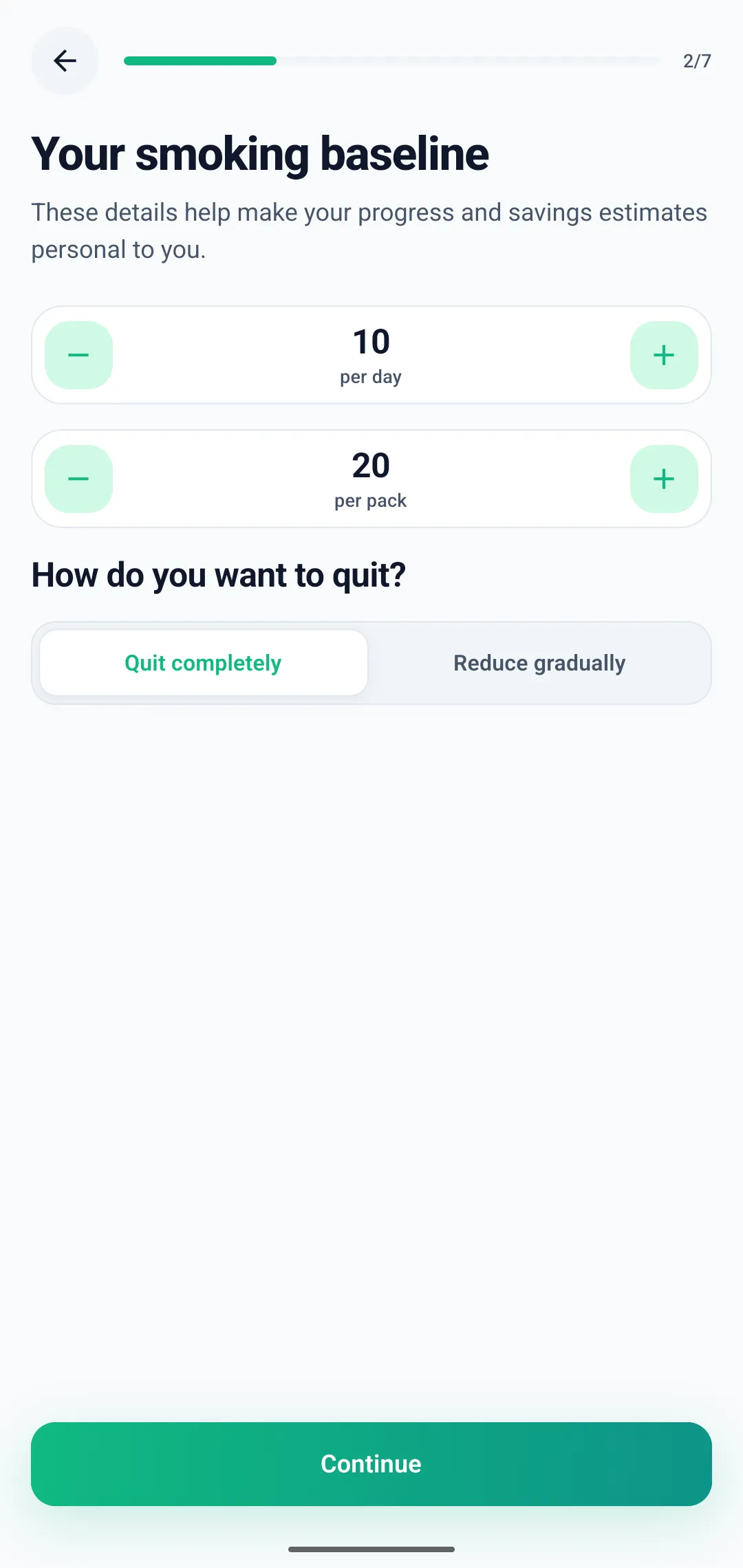
- Cigarettes per day: your honest typical day, not your best one.
- Cigarettes per pack, and then the pack price and currency on the following setup step. Together these are the basis for any savings estimate.
Everything downstream depends on these. Cigarettes avoided, money not spent, and packs skipped are all derived from the baseline you enter, which is why estimating money saved after quitting is only as accurate as the numbers you started with.
Stopping at once, or cutting down first
The same screen asks how you want to quit: Quit completely or Reduce gradually. Both are in common use, and the app treats the answer as a tracking mode rather than a verdict on method.
Worth being clear about: which approach suits you is a clinical question, not a tracking one. If you are weighing nicotine replacement, prescription options, or a taper schedule, that conversation belongs with a pharmacist, doctor, or stop-smoking service. The NHS notes that stopping is easier with the right support, and local Stop Smoking Services exist for exactly this.
What tracking adds either way is honesty about the current number. If you are reducing gradually, the daily count is the whole plan, and guessing defeats it.
Write your reasons down while you are calm
Reasons feel obvious right now. They will not feel obvious at 9pm on day three, which is precisely when you need them.
The point of recording them in advance is that you are writing while your judgement is clear, for a version of yourself whose judgement temporarily is not. Keep them concrete. “Health” is weak. “I want to climb the stairs at work without stopping” is something you can actually picture.
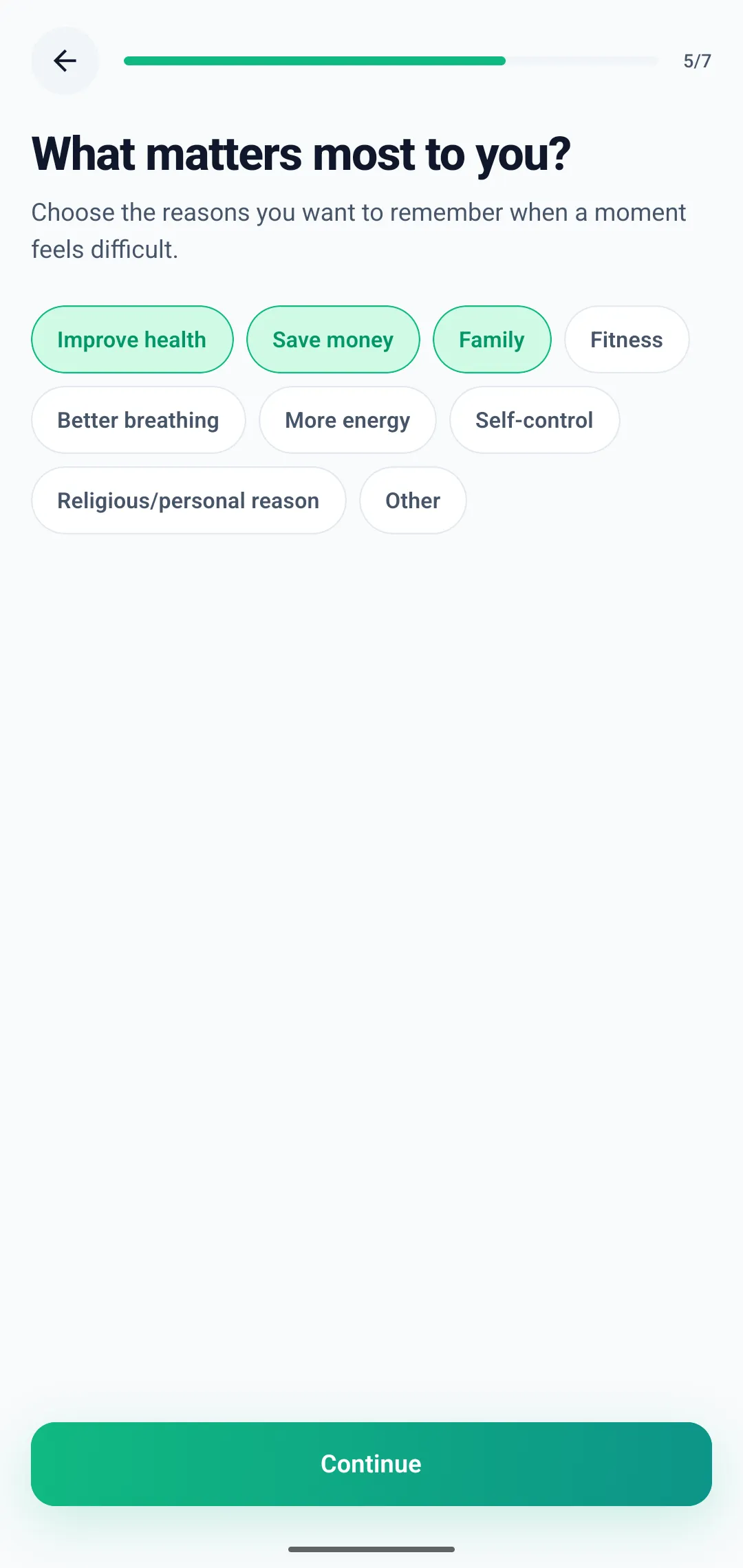
If you want more room than a set of labels, the journal takes free text, and there are quit smoking journal prompts for the pre-quit days if a blank page is unhelpful.
The week before: what to prepare
Smokefree.gov’s preparation guidance is refreshingly unmystical. Adapted into a checklist you can work through:
- Learn your triggers. Spend the week noticing when you smoke rather than trying to stop. Which situations repeat is the single most useful thing you can know on day one. The guide to common smoking triggers breaks these into routine, emotional, social, location, and time-based patterns.
- Decide your craving response now. Not “resist.” An actual action: paced breathing, a glass of water, a walk. Deciding this in advance is the entire point of a five-minute plan for when a craving hits.
- Tell at least one person the date. Smokefree.gov specifically suggests asking people not to offer you a cigarette, no matter what you say later.
- Sort out any aids in advance. If you plan to use nicotine replacement, have it before quit day rather than on it. Get the advice first.
- Plan the routine changes. If your smoking is attached to a break, a drive, or a balcony, decide now what happens in that slot instead.
- Set a reminder or two. If you already know your hard time of day, an optional reminder shortly before it is more useful than a generic daily prompt.
The day before, and quit day
The physical part is short and matters more than it looks. Smokefree.gov’s quit-day guidance is direct: throw away your cigarettes, lighters, and ashtrays if you have not already, and change the routines you associate with smoking.
Check the places that get forgotten: the car, a coat pocket, a drawer, a bag, the balcony. Leaving one packet “just in case” converts a decision you already made into a decision you have to keep re-making.
On the day itself, the useful framing is short horizons: get through this hour, then the next. Smokefree.gov suggests rewarding yourself after the first 24 hours, which is a reasonable scale to think in.
Put the date somewhere that will remember it for you
A date you have to recall is a date you can renegotiate. Once it is set in something that counts forward on its own, the record exists whether or not you feel motivated that morning.
Quit Smoking Tracker asks for this during setup and supports three cases: I quit now, I already quit earlier, and I plan to quit later. That last option is the one that matters when you are reading this before your quit day. The date and time can be entered in advance, and the dashboard adapts once the date arrives.
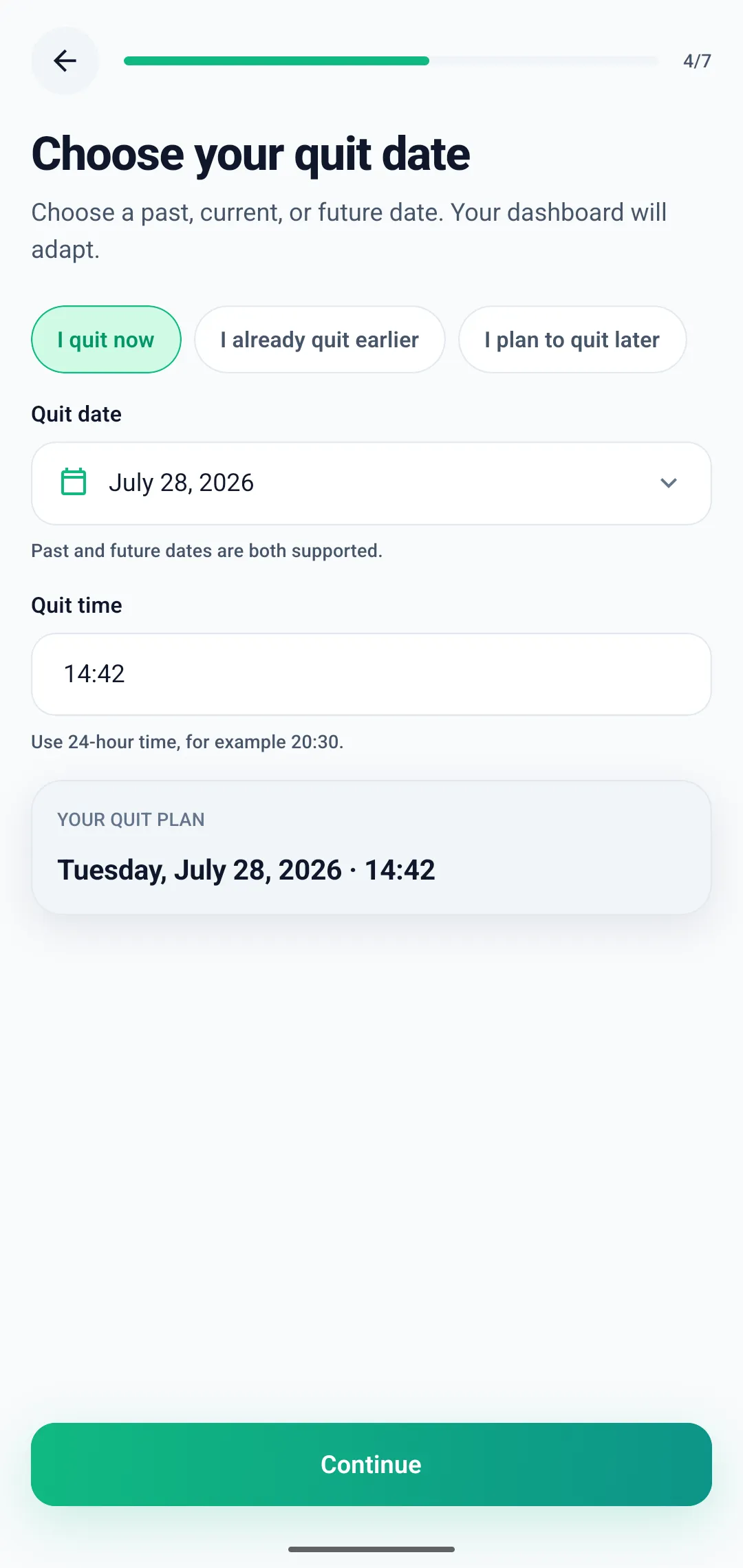
Entering a time as well as a date is worth the extra five seconds. It makes the first day’s elapsed count accurate, and the smoke-free timer then runs from a real moment rather than from midnight. If you want the detail on what each choice does to your history, the guide to tracking smoke-free days covers past, present, and future start points.
If you smoke before your quit date
Then you smoked before your quit date. The date does not need to move.
This is worth saying plainly because the alternative (treating any cigarette during the preparation week as proof the plan is already broken) is how a quit date turns into a fourth postponement. If you are reducing gradually, smoking before the date is literally the plan.
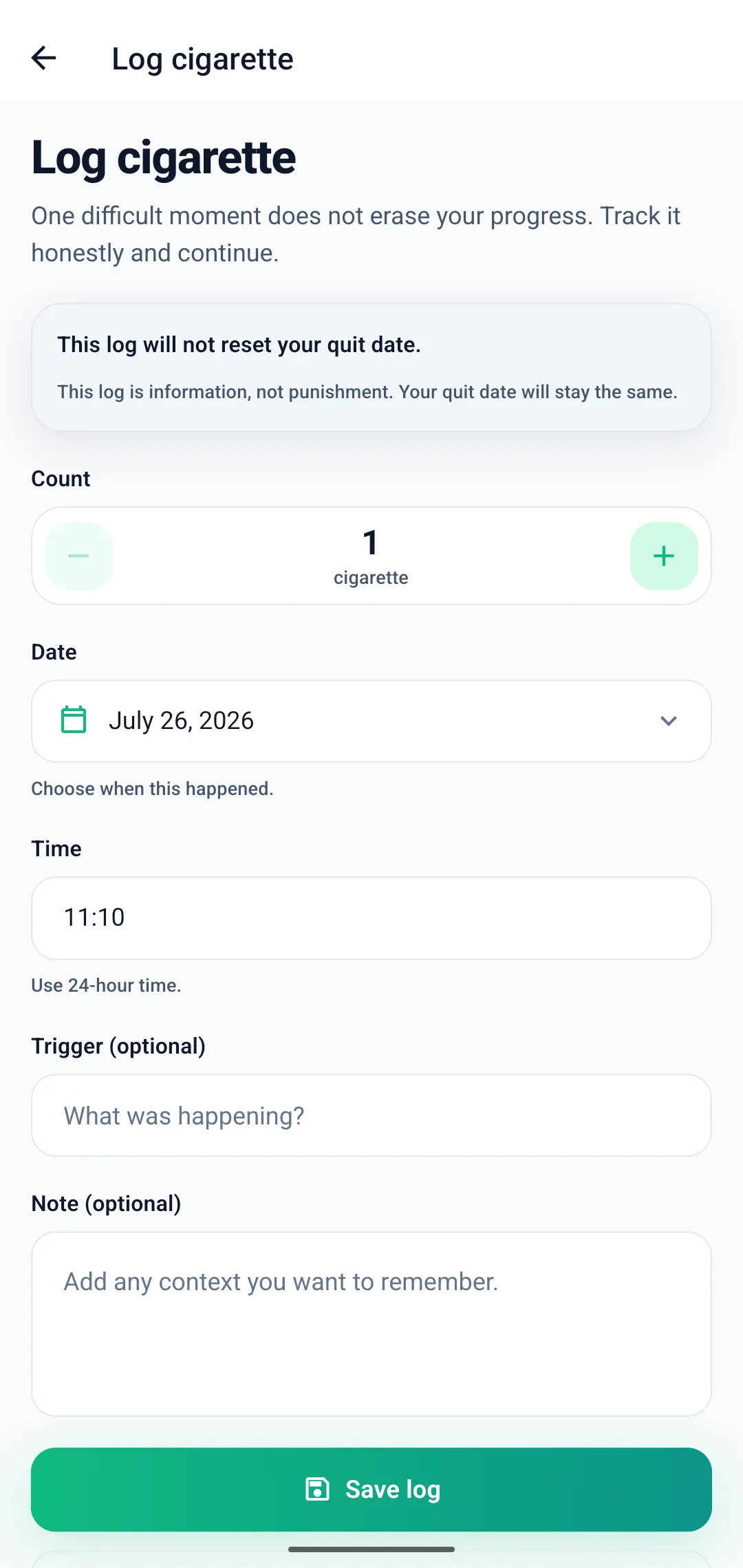
Record the count, and the trigger if you noticed one. A taper you are guessing at is not a taper, and a slip you hid is a pattern you cannot review later in the progress tracker.
Set the date, then spend the week getting ready
Pick a day in the next one to two weeks. Write down what you currently smoke and what it costs. Decide what you will do the first time a craving arrives. Clear out the cigarettes the night before. That is most of it.
Quit Smoking Tracker for Android walks through the baseline, quit date, reasons, and optional reminders during setup, and keeps the record on your device afterwards. If you would rather see how the pieces connect first, the features overview lays them out.
Sources: Smokefree.gov (National Cancer Institute): Prepare to Quit, Smokefree.gov: Steps to Quit Smoking on Your Quit Day, and NHS Better Health: Quit Smoking.
Frequently asked questions
How far in advance should I set a quit date?
Smokefree.gov, the National Cancer Institute's quit-smoking service, recommends choosing a date no more than a week or two away. That leaves room to prepare without giving motivation time to fade. A date set months ahead tends to become a date you keep moving.
What day of the week is best to quit smoking?
There is no single best day. What matters more is picking a day whose surrounding week is predictable: no major deadline, no travel, no event where you would normally smoke. A quiet Tuesday beats a symbolic Monday that lands the day before a stressful trip.
Can I set a quit date in the future and start tracking before I stop?
Yes. Quit Smoking Tracker's onboarding offers three modes (I quit now, I already quit earlier, and I plan to quit later), so a future date can be entered before quit day and the dashboard adjusts once the date arrives.
Should I cut down before my quit date or stop all at once?
Both approaches are in common use, and Quit Smoking Tracker supports either as a tracking mode with a Quit completely or Reduce gradually setting. Which one suits you is worth discussing with a doctor, pharmacist, or stop-smoking service, especially if you are considering nicotine replacement or medication.
What should I do the day before I quit smoking?
Smokefree.gov's quit-day guidance includes throwing away cigarettes, lighters, and ashtrays, and changing routines you associate with smoking. Practically, that means clearing the house and car, deciding what you will do during a craving, and telling at least one person the date.
What happens if I smoke before my quit date arrives?
Nothing about the plan has to change. In Quit Smoking Tracker, the cigarette log states that it will not reset your quit date, so the entry records what happened without erasing the date you set.
Health note: This article is for general tracking and self-reflection only. It is not medical advice, diagnosis, or treatment.

