
Disclaimer: This article is for general tracking and self-reflection only. It is not medical advice, diagnosis, or treatment.
Summary
If you smoked one cigarette after quitting, stop again now, remove the remaining cigarettes, and ask someone for support. Record the situation and choose a different response for next time. A slip does not erase your earlier effort, but it is a reason to act before smoking becomes a routine again.
You smoked a cigarette after several days or weeks without one. Now there are two things to deal with: the cigarette itself, and the thought that the whole attempt is ruined. That second thought can make it tempting to stop trying for the rest of the day, finish the pack, or avoid looking at your tracker.
You can take a useful next step before you feel better about what happened. This guide covers what to do after a smoking slip, what to write down, how to interpret your smoke-free timer, and how to prepare for the situation that caught you out. You can use the plan with a notebook or an app. The record is there to help you make a decision, alongside any professional quit-smoking support you use.
Does one cigarette mean your quit attempt has failed?
No. One cigarette after quitting does not automatically mean you have returned to regular smoking. The NHS guide to getting back on track distinguishes a lapse, such as a puff or a single cigarette, from a relapse, meaning a return to regular smoking.
That distinction gives you a useful question: what needs to happen now to keep this from becoming the usual routine again?
Take the event seriously without turning it into a judgment about yourself. Your earlier smoke-free days are still part of your history. They may contain a routine, a conversation, or a coping strategy you can use again. Keeping those records is different from claiming that smoking had no effect on your health or your current streak.
What should you do immediately after a smoking slip?
Return to not smoking now. Remove the remaining cigarettes and get support rather than waiting for the next week or a fresh pack. Health Canada’s advice after a slip recommends stopping immediately, removing cigarettes and smoking accessories, and asking for help.
Make the next few actions concrete:
- Put out the cigarette. You do not have to finish it because you started it.
- Remove easy access. Dispose of the remaining cigarettes and move lighters and ashtrays out of your smoke-free space. Keeping a pack nearby to test yourself creates another decision to face.
- Change the setting. Leave the smoking area. Get some water, brush your teeth, or move into a different activity.
- Ask for a specific kind of support. For example: “I smoked today and I’m stopping again. Please don’t offer me cigarettes on our break.”
- Choose the next smoke-free action. That might be taking lunch somewhere else or calling a supportive person before the journey home.
If another urge is already building, use the separate five-minute plan for a cigarette craving. You can write about the slip once you have stepped away from the situation.
Record what happened without rewriting the whole day
A useful slip record describes an event you can act on. “I have no willpower” does not tell you what to change. “I accepted a cigarette outside work after a tense call” does.
Write down:
- the date, approximate time, and number of cigarettes;
- what happened just before smoking;
- where you were and whether cigarettes were offered or already available;
- the urge or mood you noticed, if you remember;
- one thing you could change when the situation repeats.
An example note might read: One cigarette at 4:30 p.m., outside the office after a difficult call. I joined the usual smoking break. Tomorrow I will call my sister and take a different route outside.
Quit Smoking Tracker has a cigarette log for the event itself. The craving tracker can add intensity, trigger, mood, and an outcome. When recording a craving that ended in smoking, turn off I resisted so the entry reflects what happened. Recording craving context and recording the cigarette count serve different purposes; one should not be assumed to replace the other.
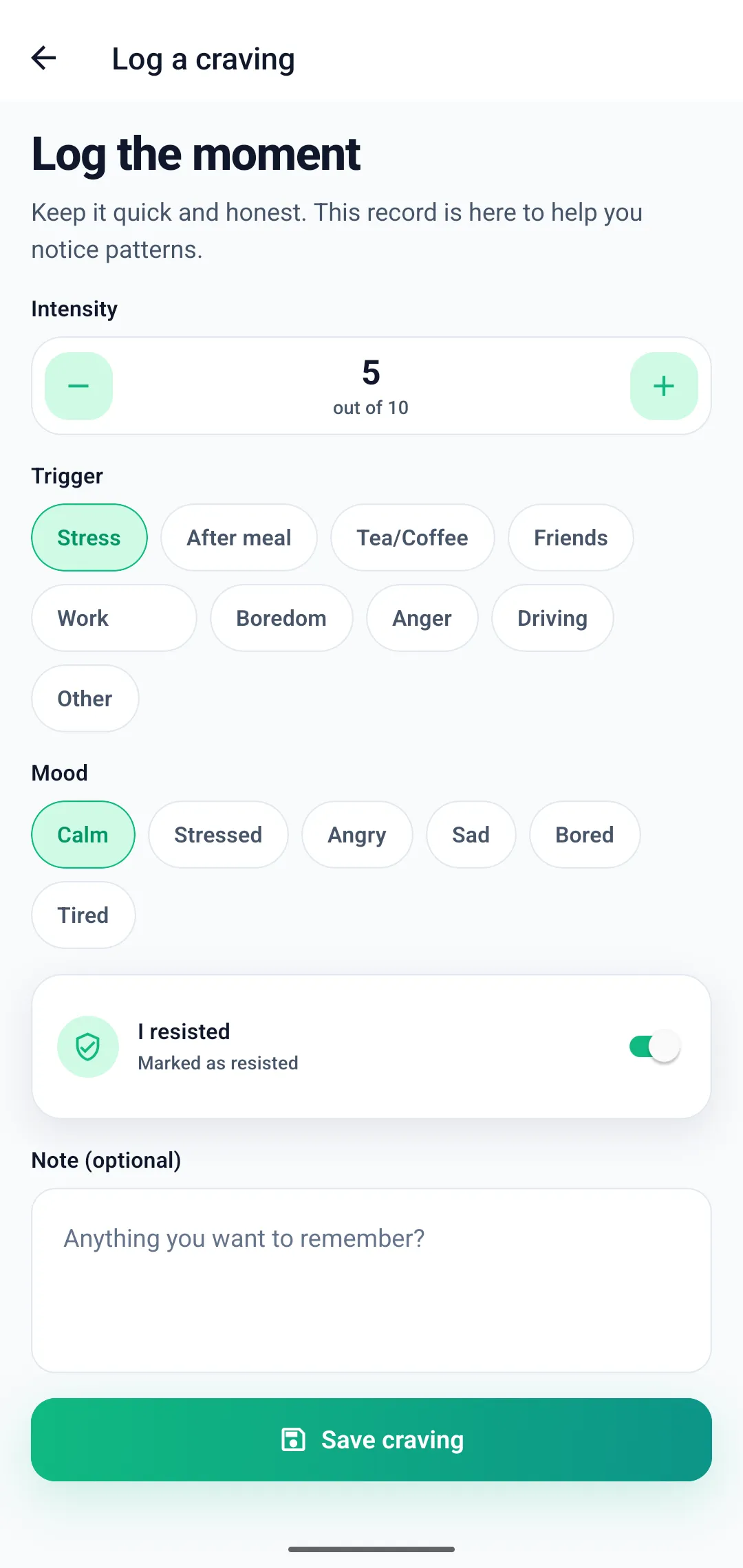
You do not need to fill every field or reconstruct an exact intensity from memory. A brief, accurate note is enough to start planning.
Should you reset your smoke-free timer after one cigarette?
If your timer means continuous time without smoking, its starting point should be your last cigarette. Your original quit date can remain part of your wider journey record. Those two dates answer different questions.
For example, suppose you first stopped on October 1 and smoked a cigarette on October 20. On October 21, you are 20 days into the overall attempt, but you have not been continuously smoke-free for 20 days. You can acknowledge the earlier days while accurately counting the current interval.
In Quit Smoking Tracker, the cigarette log explicitly says it will not reset your quit date. You can also update the timer’s starting information. Logging a cigarette and deciding what the timer should represent are therefore separate actions. Check the displayed start date rather than assuming the app changed it for you.
Before changing that date, note your original starting point if you want to remember it. Timer changes can also affect related estimates, so interpret the numbers using the starting information you selected. Avoid deleting the whole journey record just to make a counter start over.
Turn the slip into one change for next time
Pick the part of the situation you can change before it happens again. “Try harder” is difficult to carry out. “Take my break at the café instead of the smoking area” gives you somewhere to go.
The National Cancer Institute’s Smokefree.gov guidance on setbacks encourages looking at why the slip happened and deciding what to do differently in the same situation. Use that question to write a short plan with a cue and an action.
If someone offered you a cigarette
Prepare your answer before the next gathering: “No thanks, I’m keeping going with quitting.” Ask that person not to offer again. Decide where you will spend the break, so refusing does not leave you standing beside the same cigarettes with nothing else to do.
If it happened after a stressful call
Plan the transition immediately after the call: put the phone down, leave your desk, get water, and contact someone if you need support. Write the sequence somewhere visible before your next meeting. Keep it short enough to remember when you are upset.
If it happened in an ordinary routine
Be specific about the cue. “After dinner on the balcony” tells you more than “at night.” You could arrange a different activity after dinner and keep cigarettes out of that space. The guide to common smoking triggers can help you describe a routine without needing a perfect explanation for it.
Choose one change you can actually make today. You can adjust it after seeing how the next similar situation goes.
Make a short plan for the next 24 hours
Focus on the next likely smoking opportunity: the morning coffee, work break, journey home, or evening with friends. Write when it will happen, what you will do instead, and who you can contact. Have the plan ready before that point in the day.
At the end of today, make an honest check-in. A day that included a cigarette should not be marked entirely smoke-free, even if you stopped again immediately. You can still record something useful you did afterwards, such as disposing of the pack or arranging support.
The app’s daily journal has a Smoke-free today? choice and a What helped you today? field. Choose No for a day when you smoked, then describe what helped you resume the plan. Your mood and your smoking status can be different: you do not have to choose a positive mood to complete a check-in.
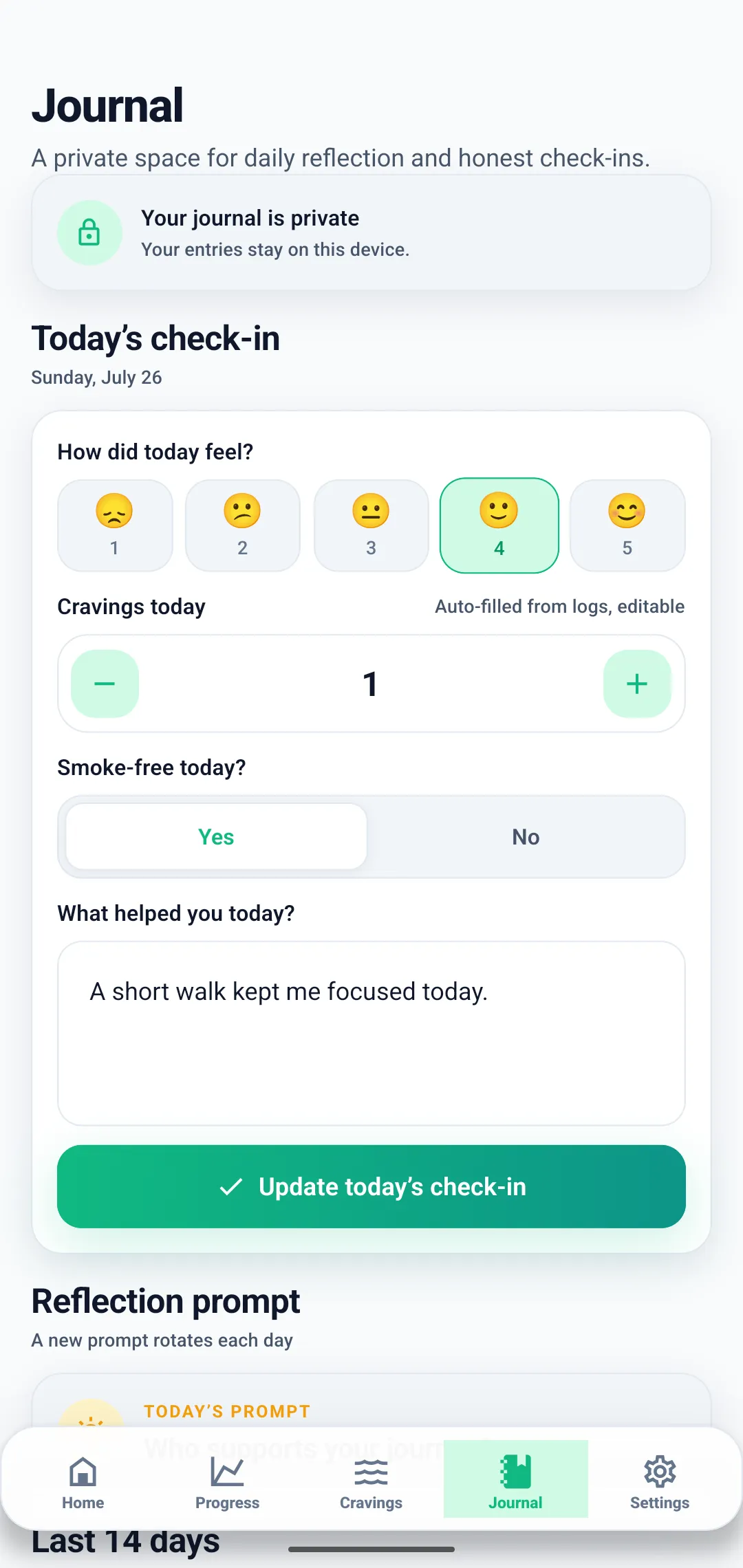
A notebook works for the same exercise. An optional check-in reminder can help you remember the review, but the important part is having a usable plan for the next difficult moment.
When should you ask for more support?
You can ask now; you do not need to wait for another slip. If cravings are hard to manage, smoking keeps recurring, or you are unsure about your treatment, speak with a qualified health professional or a local stop-smoking service.
The CDC’s guidance on quitting smoking explains that counseling and medication together offer the best chance of quitting. A professional can help you review those options for your circumstances. If you already use nicotine replacement or prescribed medicine, follow its instructions and ask a pharmacist or prescriber about any concerns after the slip. A tracking app cannot decide medication changes.
Bring a short description of what happened and what you have tried. Your notes can help explain the difficulty; you do not need a complete chart or a perfect record to ask for help.
What if you have already returned to regular smoking?
Make a fresh quit plan with support rather than treating the return to smoking as a reason to abandon the goal. Look at what helped during your earlier attempt and what needs to change this time.
Choose a definite next step: arrange a conversation with a stop-smoking adviser, prepare for stopping again, or use the guide to choosing a quit date if you need to rebuild that plan. Keep the useful parts of your earlier record available. You are planning with more information about your own situation.
For today, finish with one sentence you can follow: At my next smoking break, I will go to the café and phone someone who supports my quit attempt. Put your own place and action into that sentence, then make the arrangement while you have time to prepare.
Frequently asked questions
I smoked one cigarette after quitting. Have I failed?
A single smoking slip does not mean your quit attempt has failed. Stop again now, remove access to cigarettes, and review what happened. The aim is to keep a brief lapse from becoming a return to regular smoking.
What is the difference between a lapse and a relapse?
NHS guidance describes a puff or a single cigarette after quitting as a lapse. Returning to regular smoking is a relapse. Both call for a response, but a single slip does not require abandoning your quit attempt.
Should I reset my smoke-free timer after one cigarette?
If the timer represents continuous time without smoking, count from your last cigarette. You can separately preserve your original quit date and earlier notes. Keeping a longer journey record should not mean calling that whole period uninterrupted smoke-free time.
Can I log a cigarette in Quit Smoking Tracker without deleting my history?
Yes. Quit Smoking Tracker supports cigarette logs without automatically deleting your wider history. The cigarette log screen states that logging will not reset the quit date. Reviewing or changing the timer's starting information is a separate action.
Should I wait until Monday to quit again after a slip?
After a single cigarette, return to not smoking straight away. You do not need to finish the pack or wait for a calendar milestone. If regular smoking has resumed, arrange support and make a concrete plan to stop again.
What if I keep slipping even though I track my cravings?
Repeated slips are a reason to review your quit plan with a qualified health professional or stop-smoking service. Tracking can show situations to discuss, but a log cannot assess treatment needs or replace counseling and medication advice.
Health note: This article is for general tracking and self-reflection only. It is not medical advice, diagnosis, or treatment.

