
Disclaimer: This article is for general tracking and self-reflection only. It is not medical advice, diagnosis, or treatment.
Summary
A cigarette craving is a short spike, not a permanent state. A five-minute plan gives you something specific to do while it passes: delay the decision, breathe for a minute, switch to one small task, then record what happened.
Key takeaways
- A craving is a spike with a beginning and an end, not a state you have to endure forever.
- The plan matters more than the willpower: pick your response before the urge arrives.
- Five minutes of a specific, physical task is easier to commit to than “don’t smoke.”
- Recording the craving afterwards turns a difficult moment into information you can use.
You already know why you want to stop smoking. That is rarely the hard part. The hard part is a specific moment: you are outside a building, or the meeting just ended, or dinner is finished, and the urge arrives with a very simple, very persuasive argument. Just one.
That moment is short. It is also predictable enough to prepare for. This guide covers what to do in the five minutes after a cigarette craving starts, why a delay works better than a fight, and how to turn each craving into something you can review later instead of something you just survive. It is written for tracking and self-reflection, not as medical treatment. If you want medication options, nicotine replacement, or a structured quit program, that is a conversation for a qualified health professional.
Quick answer: what to do when a craving hits
Delay the decision for five minutes rather than trying to resist forever. In that window, do one prepared action: 60 seconds of slow breathing, a glass of water, a short walk, or a quick note about what triggered it. When the urge fades, record the craving while the details are fresh. The plan works because it replaces an open-ended fight with a short, finishable task.
- Delay: commit to five minutes, not to “never.”
- Breathe: one minute of slow, paced breathing.
- Move: one small physical task that changes the scene.
- Name it: say what the trigger and mood actually were.
- Log it: record intensity, trigger, and outcome afterwards.
Why the first few minutes decide the outcome
A craving is not a steady pressure that builds until you give in. It rises, peaks, and drops. NHS guidance on smoking triggers puts it plainly: cravings usually only last a few minutes, so it helps to have a distraction ready. That single fact changes the strategy. You are not trying to win an argument that lasts all evening. You are trying to stay busy through a short spike.
The National Cancer Institute describes the same pattern over a longer timeline: urges come and go, they can start within an hour or two of your last cigarette, they are frequent for the first days and weeks, and they gradually spread further apart. Withdrawal symptoms are usually worst in the first week and peak around the first three days, then ease over the first month. Occasional mild cravings can still show up months later, which is normal rather than a sign that something has gone wrong.
Two practical conclusions follow from that shape:
- Resisting is the wrong verb. You do not need to defeat the craving. You need to be occupied while it passes.
- A timer beats determination. “Five minutes” is a target you can actually hit. “Never again” is not something you can do in the next five minutes.
Step 1: Put a number on the delay
Before anything else, decide how long you are delaying. Say it out loud if that helps: five minutes, then I decide.
This works for two reasons. It converts a vague struggle into a countdown, and it removes the need to make a permanent decision while you are least able to make one. Most of the time the urge has dropped noticeably before the five minutes are up, and the decision you were dreading no longer feels urgent.
If five minutes feels too long during the first week, use two. The number matters less than having one.
Step 2: Breathe through the first 60 seconds
Slow breathing appears on both the NHS and National Cancer Institute lists of ways to cope with an urge to smoke, and the NCI’s version is deliberately simple: breathe in deeply through your nose, blow out slowly through your mouth, and repeat about ten times. That takes roughly a minute.
The value is less mystical than it sounds. Paced breathing gives your attention somewhere concrete to go, it slows down the physical restlessness that makes a craving feel like an emergency, and it fills the first and hardest stretch of your delay with something finishable.
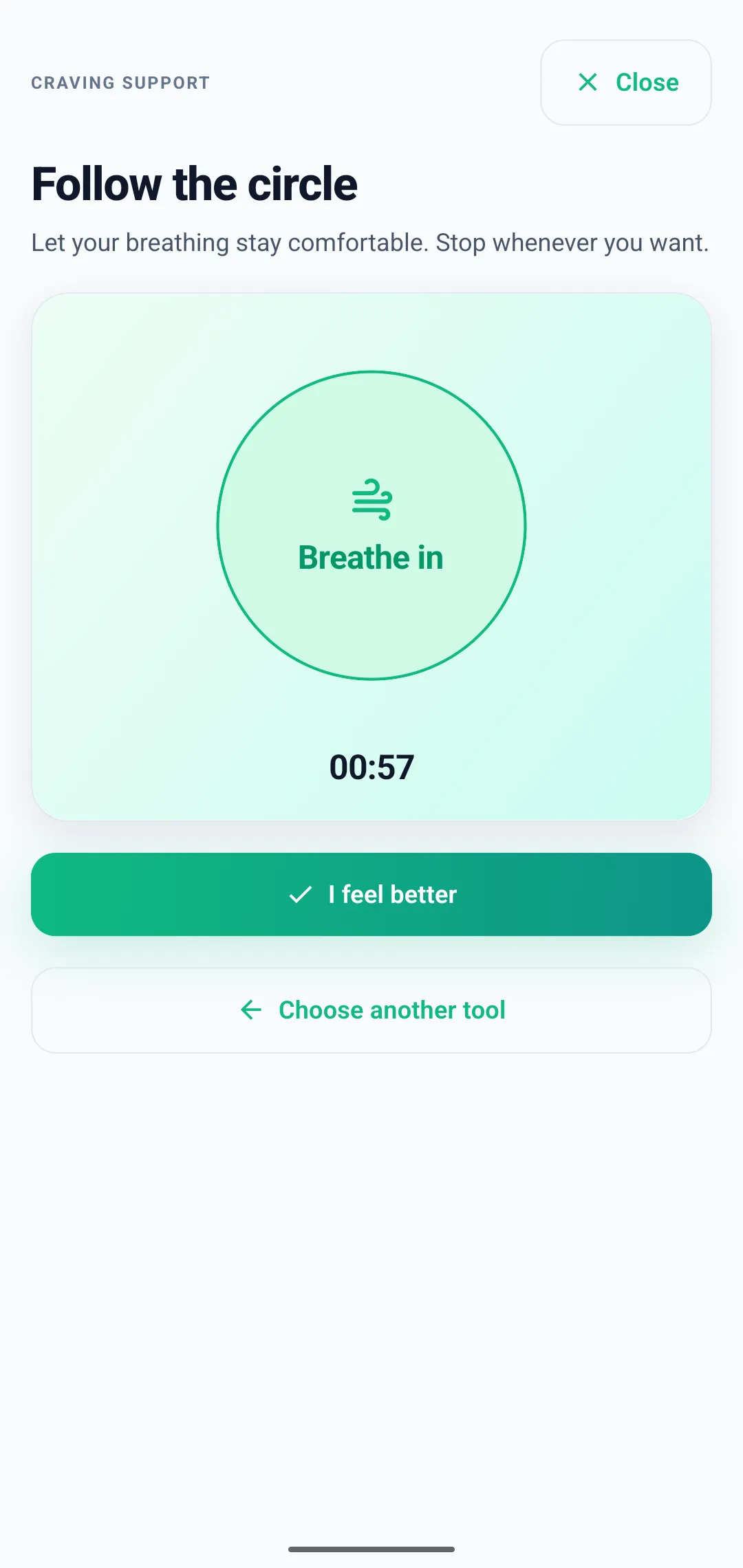
The emergency craving support screen in Quit Smoking Tracker opens on a five-minute pause with breathing as the first option, which is a useful default: it is the one step you can start immediately, anywhere, without deciding anything else first.
Step 3: Change the moment with one small task
Breathing handles the first minute. The next few are usually easier if something in your physical situation changes.
The tasks that work are almost boringly small:
- drink a full glass of water, slowly;
- wash your face or your hands with cold water;
- do ten push-ups, or stretch for a minute;
- walk to a different room, or around the block;
- put a snack, sugar-free gum, or a piece of fruit in your mouth.
Notice what these have in common. Each one occupies your hands, changes your posture or your location, and finishes on its own. None of them requires motivation, and none of them can be done while smoking. That last point is doing more work than it looks like: a lot of what makes a craving hard is that your hands and mouth are free and your surroundings are unchanged.
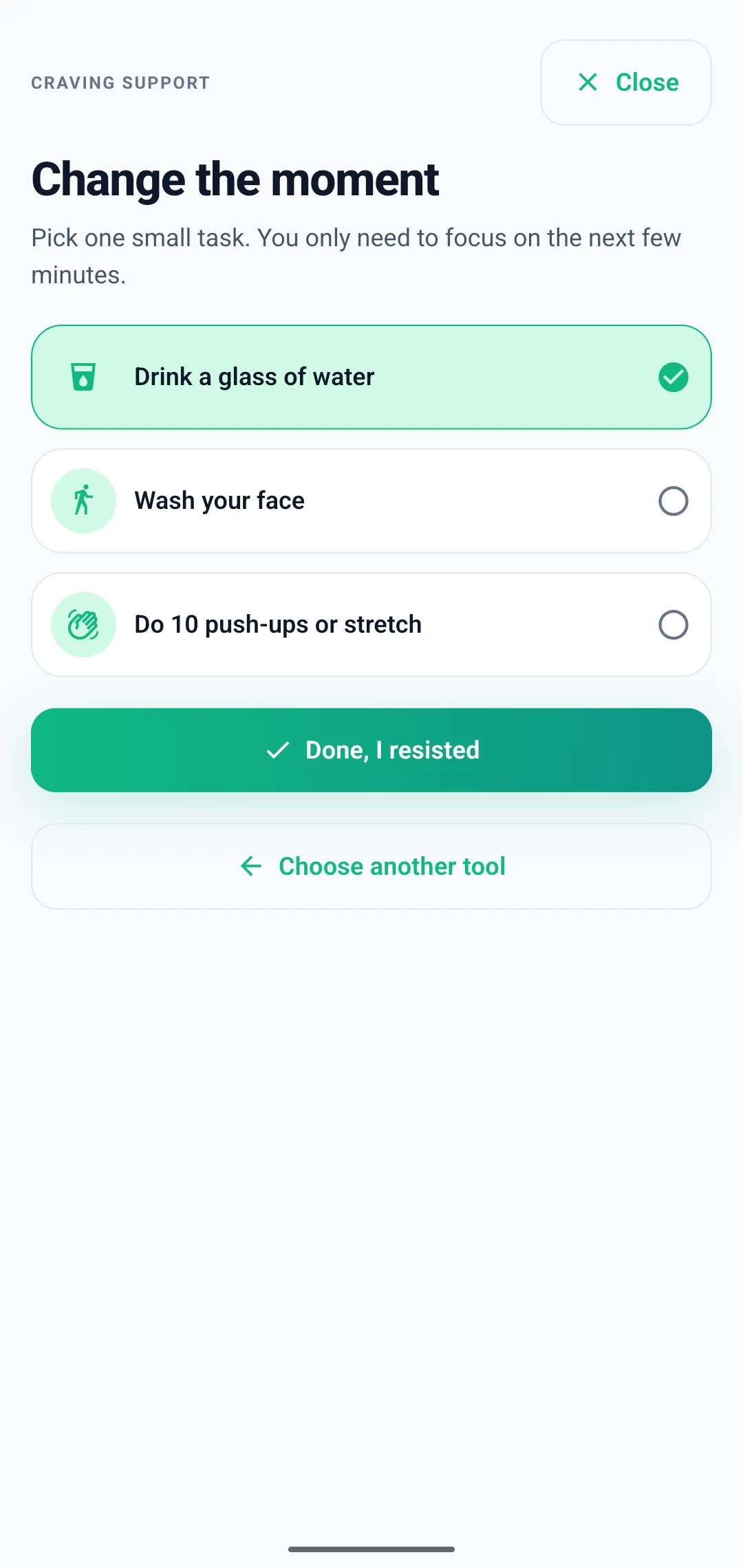
Keep your own list to three or four items. A long list becomes another thing to think about, and thinking is exactly what the craving is good at hijacking.
Step 4: Match the response to the situation you are actually in
Not all cravings are the same craving. The one after dinner is a routine cue. The one during a stressful afternoon is closer to an emotional release valve. The one at a bar with friends who smoke is mostly social. Using the same response for all three is why generic advice often fails.
A rough mapping to start from:
| What is happening | What tends to help |
|---|---|
| Just finished eating | Leave the table, brush your teeth, walk for five minutes |
| Feeling stressed or wound up | Paced breathing first, then something physical |
| Bored or waiting | Occupy your hands: a game, a message, a task you have been putting off |
| With people who are smoking | Move location, hold a drink, decide your exit line in advance |
| Wanting motivation | Reread your reason for quitting, then take one small action that supports it |
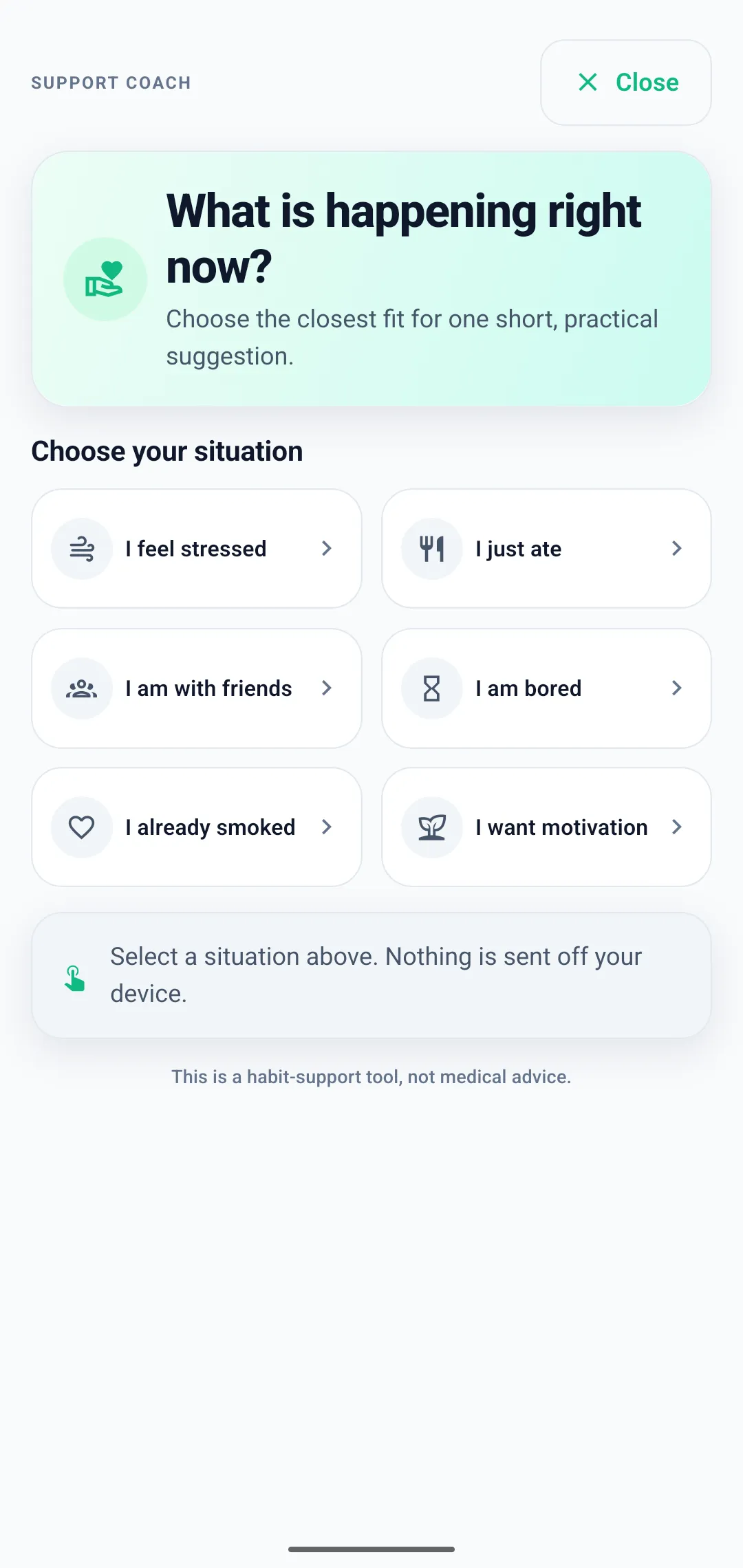
Quit Smoking Tracker builds this into a support coach screen that asks what is happening right now (stressed, just ate, with friends, bored, already smoked, or wanting motivation), and returns one short suggestion for that situation. The screen also states that nothing is sent off the device, which matters if you are the kind of person who would rather not type “I feel stressed” into an app that syncs to a server.
If you want to go deeper on identifying which of these keeps recurring for you, the guide to common smoking triggers and how to track them covers the routine, emotional, social, location, and time-based patterns in more detail.
Step 5: Log it while the details are fresh
Once the craving passes, you have about a minute where you still remember what actually happened. Use it.
A useful entry is short: intensity on a 1 to 10 scale, the trigger in a few words, your mood, whether you resisted, and an optional note. That is enough to be searchable to your future self, and small enough that you will still do it on a bad day.
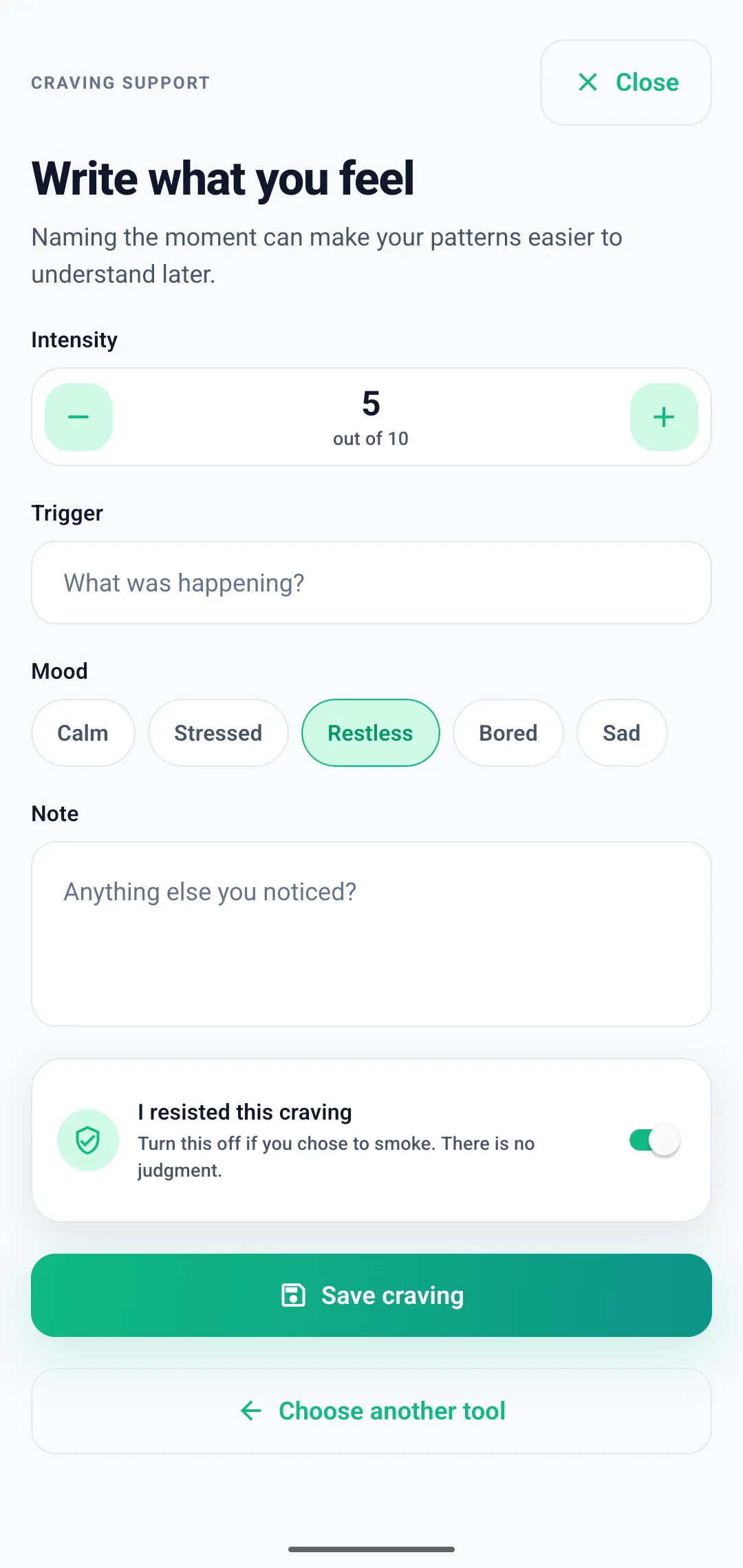
The point of logging is not to score yourself. It is that a week of entries answers questions memory cannot. Do strong cravings cluster around a particular hour? Does “stressed” appear more often than “bored”? Which triggers show up on the days you resisted, and which show up on the days you didn’t? The craving tracker keeps those entries in a dated list, and the progress tracker shows them next to your smoke-free time so a difficult week has context rather than just a number.
If a craving needs more space than a few fields (a hard conversation, a bad day, a reason you want to remember), the journal is the better place for it. There is a set of quit smoking journal prompts if a blank page feels like too much.
Decide your plan before the next craving
Everything above works better when it is decided in advance. Write your plan down somewhere you will actually see it, in one sentence:
When a craving hits, I will delay five minutes, breathe for one of them, drink a glass of water, and log it afterwards.
Then make it visible before you need it. If your cravings cluster around a predictable time (the drive home, the first hour after dinner, mid-afternoon at work), an optional reminder a few minutes beforehand is more useful than one at a random time of day. If reminders start feeling like noise, turn them off. A prompt you ignore is worse than no prompt.
Some people also find it worth removing the easy path: no lighter in the usual pocket, no cigarettes in the car, a different route past the shop where you used to stop. This is not willpower, it is friction, and friction is cheaper.
Mistakes that make cravings harder than they need to be
- Treating every craving as a test of character. It is a cue and a response, not a referendum on whether you really want this.
- Having no plan, or having five. One prepared action beats a menu you have to choose from under pressure.
- Waiting for the craving to be “gone” before you move on. You are waiting for it to be manageable, which happens much sooner.
- Bargaining mid-craving. “Just one” is the negotiation. The five-minute delay exists so you are not having it.
- Only tracking the good days. Cravings you gave in to are the most informative entries you have.
- Deleting the whole record after a slip. That destroys the only evidence you had about what went wrong.
If you smoke anyway
It happens, and how you handle the next ten minutes matters more than the cigarette did.
Record it. Note the trigger, the intensity, and what was going on. Then decide, deliberately, what your smoke-free timer should say. Some people reset it because a clean start is motivating, others keep the longer history and mark the event, and both are legitimate tracking choices rather than moral ones. The guide to tracking smoke-free days walks through what each approach does to your history.
What is worth avoiding is the pattern where one cigarette leads to abandoning the record, which leads to losing track of the pattern that caused it. A log with a gap in it is still a useful log.
And if cravings are severe, persistent, or coming with symptoms you find hard to manage, that is a reason to talk to a doctor, pharmacist, or a local stop-smoking service rather than to try harder on your own. Tracking tools sit alongside that kind of support; they do not replace it.
Keep the plan where the craving happens
The craving will not arrive while you are reading an article about cravings. It will arrive with your phone in your hand. That is the argument for having the plan on the phone rather than in your head.
Quit Smoking Tracker for Android keeps the five-minute pause, the breathing prompt, the distraction list, the situation-based suggestions, and the craving log in one flow, with entries stored on your device. If you would rather see how the pieces fit together first, the craving support feature overview lays them out.
Sources: NHS Better Health: Understand your smoking triggers and cravings and National Cancer Institute: Handling Nicotine Withdrawal and Triggers When You Decide to Quit Tobacco.
Frequently asked questions
How long does a cigarette craving last?
An individual craving is usually short. NHS guidance describes cravings as lasting only a few minutes, which is why a prepared distraction helps more than trying to out-wait an urge indefinitely. Cravings also tend to become less frequent over the weeks after quitting, though occasional ones can appear much later.
What should I do the moment a craving hits?
Delay the decision for five minutes and do one specific thing during that window: paced breathing, a glass of water, a short walk, or a quick craving log. Choosing the action ahead of time means you are not negotiating with yourself while the urge is at its strongest.
Does a breathing exercise help during a craving?
Paced breathing gives you a defined task for the first minute of a craving instead of an open-ended fight. The National Cancer Institute lists slow breathing among its coping tips for urges to smoke. It is a self-support technique, not a treatment.
Should I log a craving after it passes?
Logging is optional, but a short entry with intensity, trigger, and mood makes patterns visible later. A week or two of entries is usually enough to reveal the times and situations that repeat.
What if I smoke during a craving?
Record what happened and keep the rest of your history. One cigarette is information about a trigger, not a reason to delete weeks of tracking. Whether you reset your smoke-free timer is a separate choice, and it is yours to make.
Can an app stop cigarette cravings?
No. No app can remove a craving. What a tracking app can do is hold your prepared response, give you a place to record what happened, and build a history you can review. For medical guidance or treatment options, speak with a qualified health professional.
Health note: This article is for general tracking and self-reflection only. It is not medical advice, diagnosis, or treatment.

