
Disclaimer: This article is for general tracking and self-reflection only. It is not medical advice, diagnosis, or treatment.
Summary
Nicotine withdrawal usually starts within a few hours of your last cigarette and is strongest in the first week, especially the first three days. The worst symptoms typically pass within two weeks, and on average symptoms last three to four weeks. Cravings become less frequent but can return occasionally for months. A short daily log of mood and cravings shows whether your own symptoms are easing.
The first cigarette you don’t smoke is rarely the hardest one. The hard part tends to arrive a day or two later: you are short-tempered over nothing, you can’t settle at night, and the urge to smoke feels louder than it did on quit day. It is easy to read that as a sign that quitting is not working.
Usually it means the opposite. Those are common symptoms of nicotine withdrawal, and they follow a fairly predictable shape. They start within hours, build to a peak over the first few days, and fade over the following weeks. Knowing that shape makes a bad day three easier to put in context.
This guide walks through the nicotine withdrawal timeline from the first hours to the months after, explains why different symptoms ease at different speeds, and shows a simple way to check whether your own symptoms are easing. It draws on guidance from the National Cancer Institute, the NHS, and Smokefree.gov. It is not a substitute for advice from a doctor, pharmacist, or stop-smoking service.
Quick answer: how long nicotine withdrawal lasts
Nicotine withdrawal usually starts within a few hours of your last cigarette and is strongest during the first week, especially the first three days. The worst symptoms typically pass within about two weeks. On average, symptoms last three to four weeks in total, though some people feel them for a few months, and occasional cravings can return long after the other symptoms have gone.
What nicotine withdrawal is
Nicotine withdrawal is the set of physical and emotional symptoms that appear while your body adjusts to no longer getting nicotine. Smokefree.gov puts it simply: nicotine is what makes tobacco addictive, and the lack of nicotine after quitting is what causes withdrawal symptoms.
The National Cancer Institute’s withdrawal fact sheet lists the most common symptoms as:
- cravings for nicotine;
- anger, frustration, and irritability;
- anxiety;
- low mood or depression;
- restlessness;
- trouble sleeping;
- difficulty concentrating;
- increased hunger or appetite.
Less common symptoms include headaches, tiredness, dizziness, coughing, mouth ulcers, and constipation. Not everyone gets every symptom, and how strongly each one shows up varies from person to person.
Nicotine withdrawal timeline at a glance
| Time since last cigarette | What is common | Worth noting |
|---|---|---|
| First few hours | First cravings, often within an hour or two | When the first strong urge arrived |
| Days 1–3 | Symptoms build and usually peak: cravings, irritability, anxiety, low mood, poor sleep | Craving intensity, mood, and sleep |
| Days 4–7 | Still the hardest week overall, but the peak is usually passing | Which triggers and times of day repeat |
| Weeks 2–4 | Irritability, anxiety, and low mood ease; cravings become less frequent | Weekly craving count and average intensity |
| Month 2 onward | Many people are past the main symptoms; some notice them for a few months | Where and when the remaining cravings appear |
These timings are typical ranges drawn from NCI and NHS guidance, not a schedule your body has to follow. Your own timeline may run faster or slower.
The first few hours: cravings start early
Cravings can begin within an hour or two of your last cigarette, according to the National Cancer Institute, and the NHS guide to managing withdrawal notes that withdrawal can start within a few hours. Anxiety may begin within the first 24 hours, and mild low mood can start on the first day.
Much of the first day is predictable. The NHS guidance on triggers and cravings notes that urges are often strongest at the times of day when you used to smoke. For most people that means a short list of moments: waking up, the first coffee, the commute, the first break at work, the end of a meal.
Plan for those specific moments rather than for “the day.” If you set your quit date with a preparation week, this is where that preparation pays off, and the guide to choosing a quit date has a checklist for the days before.
Days 1 to 3: when withdrawal usually peaks
Both the NHS and the National Cancer Institute place the peak of nicotine withdrawal in the first week, and especially in the first three days. This is when cravings tend to be most frequent, irritability is closest to the surface, and sleep is most likely to be broken.
Knowing the peak is coming changes how you read it. A rough third day is not evidence that quitting will keep getting harder. It is usually the top of the curve.
A few things make these days easier to get through:
- Keep the schedule light. Where you can, avoid stacking a major deadline or a late night onto the first three days.
- Cut back on caffeine. NCI and Smokefree.gov both suggest reducing coffee, tea, and other caffeinated drinks for a while to ease irritability, anxiety, and restlessness.
- Move. A walk, chores, or any short burst of activity is a practical answer to restlessness and low mood.
- Have one prepared craving response. The five-minute plan for when a cigarette craving hits covers delaying the decision, paced breathing, and a single distraction task.
- Ask about medication or nicotine replacement. The CDC notes that medications can help you manage withdrawal symptoms and cravings. A doctor, pharmacist, or stop-smoking service can tell you which options suit you.
Days 4 to 7: still hard, but more predictable
The first week as a whole is usually the most difficult. Smokefree.gov’s withdrawal guidance also points out that it is when you are most at risk of slipping. By the second half of the week, though, it is often easier to see a pattern in when cravings arrive.
This is a good point to look back over the first few days. Not to grade yourself, but to answer one question: when were the hard moments? If the answer is “after dinner” or “the drive home,” you know where tomorrow’s difficult minutes will be.
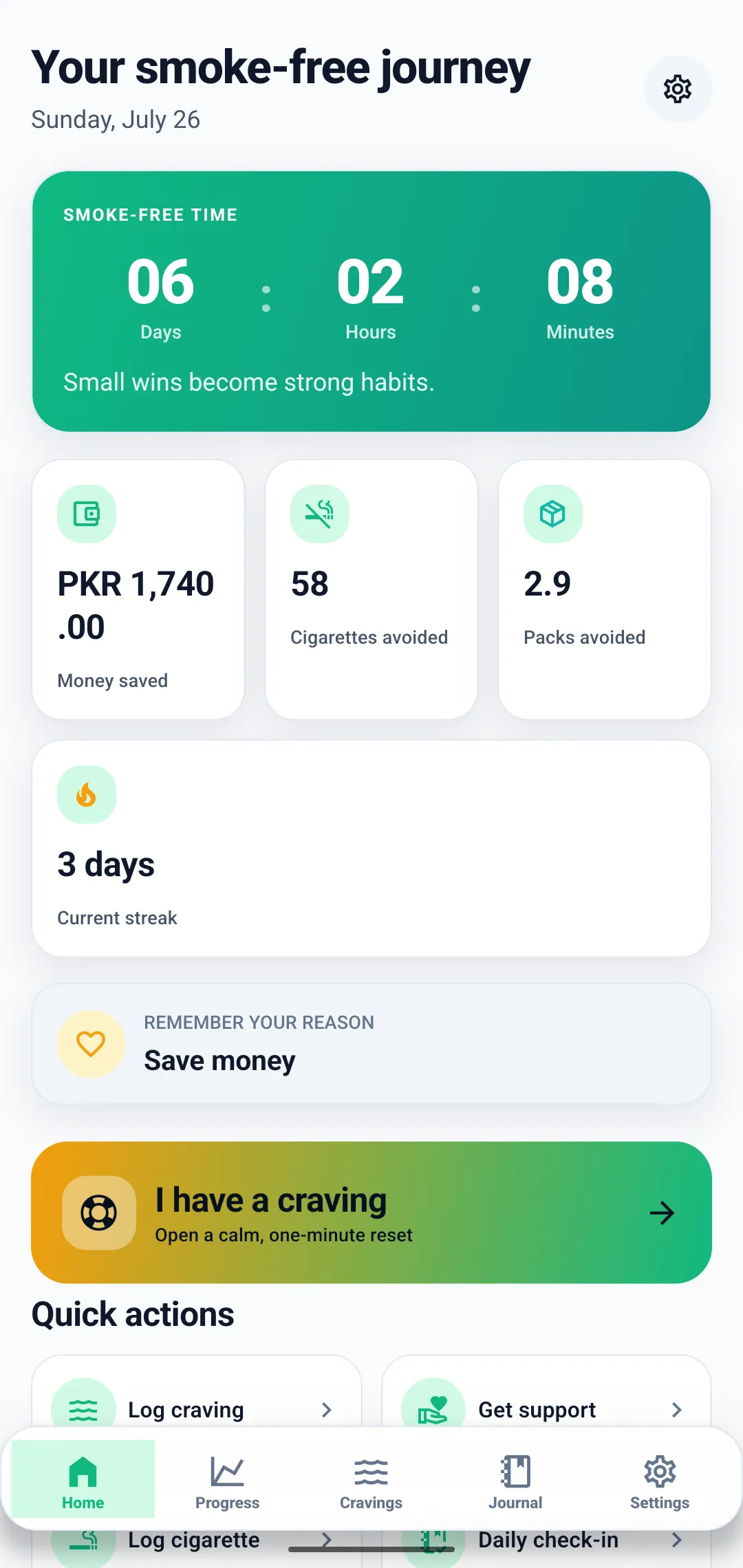
Quit Smoking Tracker’s home screen shows the live smoke-free timer alongside an I have a craving button that opens the app’s craving support tools, so checking your progress and getting through an urge start from the same place.
If you do smoke during this week, the guide on what to do after one cigarette explains how to respond straight away and how to keep your record honest without discarding the days before it.
Weeks 2 to 4: symptoms ease at different speeds
By the second week, the intensity of withdrawal usually starts to drop. Smokefree.gov says the worst withdrawal symptoms only last a few days to a couple of weeks, and the NHS puts the average total length at three to four weeks. Those two figures fit together: the sharpest part is short, and a milder tail follows it.
That tail is uneven. Different symptoms settle on different timelines, which is why week three can feel easy one day and frustrating the next.
Irritability and restlessness
NCI says irritability usually peaks within the first week and can last two to four weeks. Physical activity and cutting back on caffeine are the practical steps both NCI and Smokefree.gov suggest. It can also help to tell the people you live or work with that the first few weeks may be shorter-tempered than usual.
Anxiety
According to NCI, anxiety may begin within 24 hours of quitting, build over the first three days, and last several weeks. If you used to smoke to unwind, a few anxious weeks can feel backwards. Setting aside quiet time in the morning and evening, staying active, and using slow breathing are among NCI’s suggestions.
Trouble sleeping
Broken sleep is one of the common symptoms. Smokefree.gov’s suggestions are practical: keep the same bedtime and wake time, keep screens out of the bedroom, and limit caffeine, alcohol, and large meals near bedtime. If you use a quit medication and think it is affecting your sleep, ask your prescriber or a pharmacist rather than stopping it on your own.
Appetite and weight
Increased hunger is common after quitting. NCI notes that weight gain is usually less than 10 pounds (about 4.5 kg), and that the health benefits of quitting far outweigh the risks of that small gain. Crunchy snacks such as carrots or raw nuts keep your hands and mouth busy, which Smokefree.gov says can also help with cravings.
Concentration
Some people find it harder to concentrate, or feel foggy, in the days after quitting. Smokefree.gov’s view is that this too shall pass. In the meantime, shorter blocks of work and fewer demanding tasks in the first week or two can take some of the pressure off.
Low mood
Mild low mood usually starts within the first day, lasts a couple of weeks, and goes away within a month, according to NCI. NCI also notes that people with a history of depression often have more severe withdrawal and may have a new episode of depression after quitting. If that applies to you, tell your doctor before or as you quit, not after weeks of struggling.
Month 2 and beyond: what later cravings look like
The NHS describes cravings as hardest in the first 28 days, and NCI notes that they become less frequent over time. What often changes after the first month is how cravings show up. Instead of a steady background pull through the day, the remaining urges tend to appear around specific situations: a night out, a stressful week at work, a visit to a place where you used to smoke.
NCI also notes that occasional mild cravings can appear months or even years after quitting. That is worth knowing in advance. A craving in month three does not mean withdrawal has come back. More often, a cue you have not met for a while has turned up again.
The guide to common smoking triggers covers how to identify routine, emotional, social, and location-based cues, so a rare craving does not catch you off guard.
How to track nicotine withdrawal symptoms
Withdrawal is hard to judge from memory. The worst craving of the week is easy to remember. The quieter afternoon that followed it is easy to forget. A short daily record answers the question that matters most in weeks two to four: is this getting easier?
You do not need a detailed symptom diary. Two small records are enough, whether you keep them in a notebook or an app.
Log cravings when they happen
For each craving worth noting, record:
- intensity, on a simple scale such as 1 to 10;
- trigger, if you noticed one;
- mood, in a word;
- outcome, whether you resisted or smoked.
In Quit Smoking Tracker, the craving tracker quick log takes those four details in a few taps. Its mood options include Stressed, Angry, Sad, Bored, and Tired, which cover several of the feelings withdrawal tends to bring, so a craving entry doubles as a quick note on how the day is going.
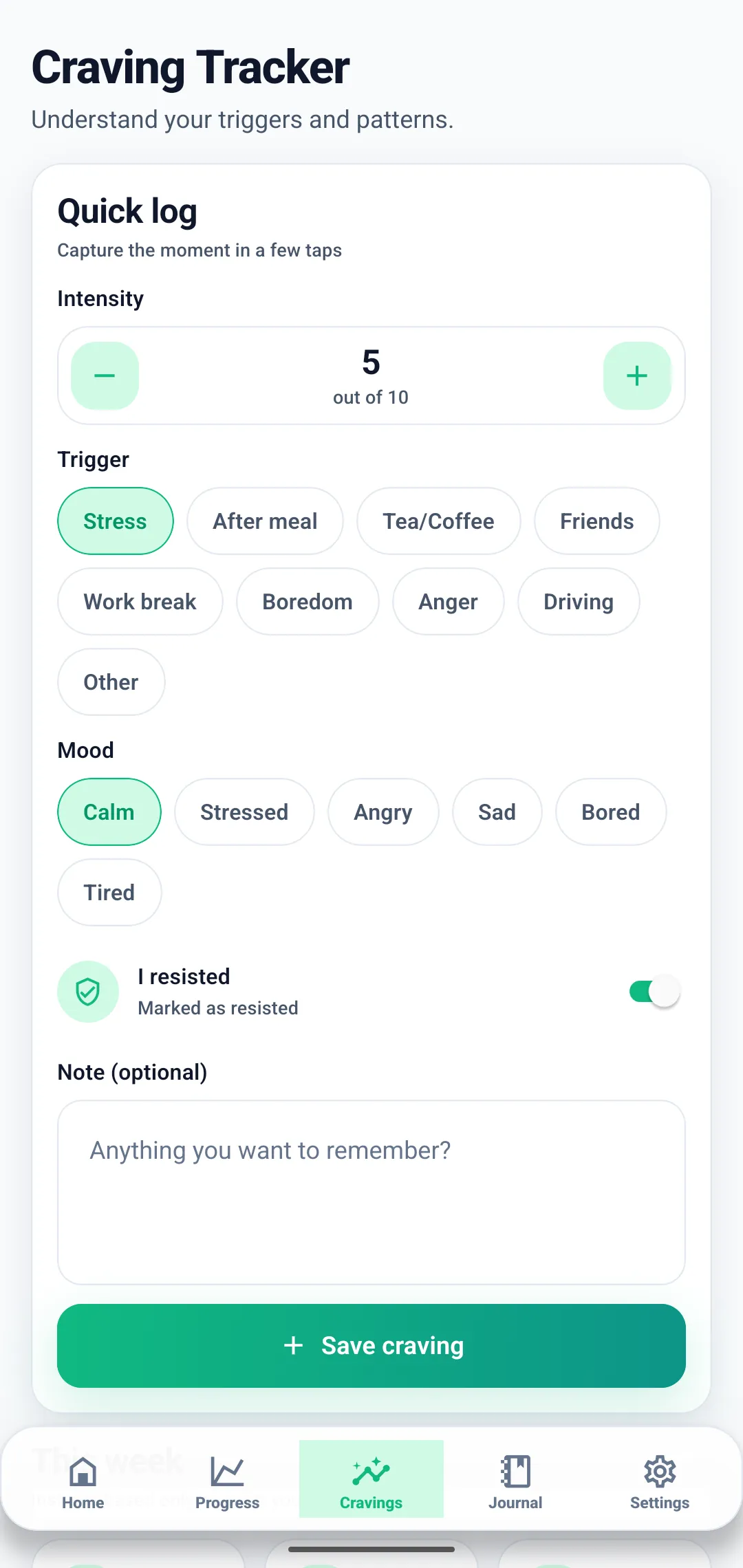
The Cravings tab then summarizes the current week with an average intensity, the most common trigger, and the number of cravings you resisted.
Add one daily check-in
Once a day, note your overall mood, roughly how many cravings you had, whether the day was smoke-free, and anything else worth remembering, such as how you slept. The app’s daily journal check-in has a five-point mood scale from Very difficult to Great, a craving count, a Smoke-free today? choice, and a free-text field. A Last 14 days view then marks smoke-free days, craving days, and cigarette days at a glance. If you would like to write more, there are quit smoking journal prompts to start from.
Compare weeks, not hours
Withdrawal does not ease in a straight line. Day nine can be worse than day eight. Look at the week instead.
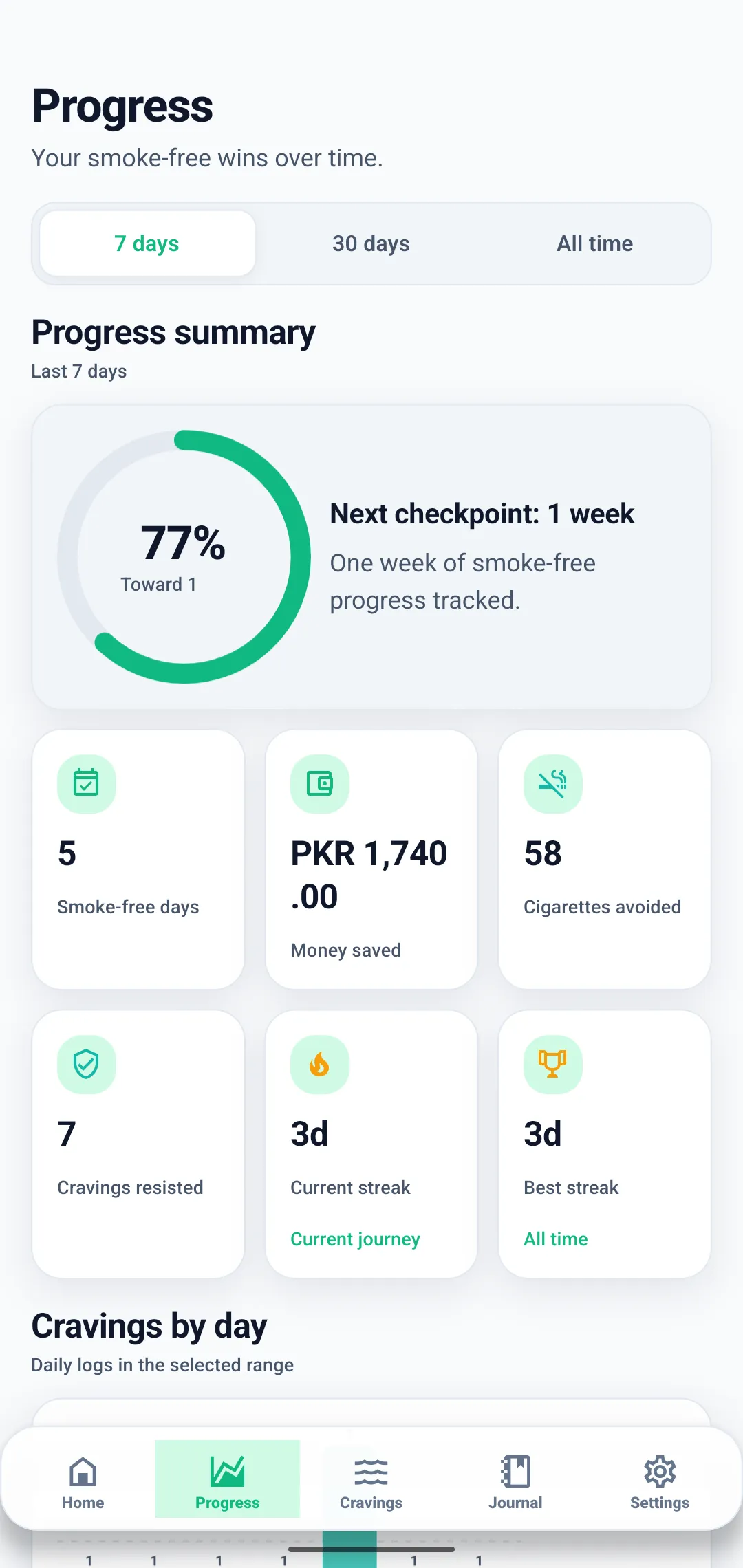
The progress tracker switches between the last 7 days, the last 30 days, and all time, with smoke-free days, cravings resisted, streaks, and a Cravings by day chart. Its journey checkpoints at one day, three days, one week, two weeks, and one month happen to line up with the stages above. The app labels them as personal checkpoints, not health outcomes, and that is the right way to read them. For more on choosing which daily signals to keep, see the quit smoking progress tracker guide.
Signs that nicotine withdrawal is easing
By weeks two to four, these are the signals worth looking for in your log:
- fewer cravings per day than in your first week;
- lower average craving intensity;
- longer gaps between cravings, including whole parts of the day without one;
- more daily check-ins rated Okay or better;
- steadier sleep;
- cravings clustering around one or two situations instead of appearing all day.
None of these has to be true every day. A trend across a week or two is what matters.
When to get extra support
Withdrawal is temporary, but you do not have to get through it alone. Speak to a doctor, pharmacist, or local stop-smoking service if:
- withdrawal symptoms are making it hard to stay quit, especially in the first two weeks;
- you want to try nicotine replacement or prescription medication;
- low mood gets worse, does not lift within a month, or you have a history of depression;
- trouble sleeping continues for weeks;
- you keep returning to smoking.
The CDC notes that using counseling and medication together gives people the best chance of quitting for good. If you are in distress or thinking about harming yourself, contact emergency services or a crisis line straight away. In the US, you can call or text 988.
A tracking app can show you patterns worth discussing, but it cannot assess symptoms or decide on treatment.
The short version
Nicotine withdrawal follows a recognizable arc. It starts within hours, peaks over the first three days, eases through weeks two to four, and leaves only occasional cravings after that. Knowing where you are on that arc turns a bad day into an expected one.
If you would like to see your own timeline rather than a general one, Quit Smoking Tracker for Android keeps craving logs, daily check-ins, and weekly progress on your device, with no account required. The features overview shows how the pieces connect.
Sources: National Cancer Institute: Handling Nicotine Withdrawal and Triggers When You Decide to Quit Tobacco, NHS Better Health: Managing nicotine withdrawal symptoms, NHS Better Health: Understand your smoking triggers and cravings, Smokefree.gov: Managing Nicotine Withdrawal, Smokefree.gov: Nicotine Withdrawal, and CDC: How to Quit Smoking.
Frequently asked questions
What day is nicotine withdrawal the worst?
The first three days are usually the hardest. NHS and National Cancer Institute guidance both place the peak of nicotine withdrawal in the first week, especially the first three days after the last cigarette. Symptoms usually begin to ease after that.
What are the symptoms of nicotine withdrawal?
Common symptoms include cravings, irritability or anger, anxiety, low mood, restlessness, trouble sleeping, difficulty concentrating, and increased appetite. Less common ones include headaches, tiredness, dizziness, coughing, mouth ulcers, and constipation.
When do cigarette cravings stop after quitting?
Cravings are most frequent in the first days and weeks, and the NHS describes the first 28 days as the hardest. They become less frequent over time, but the National Cancer Institute notes that occasional mild cravings can appear months or even years after quitting.
Is it normal to feel depressed after quitting smoking?
Mild low mood is a recognized nicotine withdrawal symptom. The National Cancer Institute says it usually starts within the first day, lasts a couple of weeks, and goes away within a month. If low mood is severe, gets worse, or you have a history of depression, talk to a health professional.
Why am I so hungry after quitting smoking?
Increased appetite is a common nicotine withdrawal symptom. The National Cancer Institute notes that weight gain after quitting is usually less than 10 pounds. Crunchy snacks, regular meals, and physical activity can help, and a doctor or pharmacist can advise on options that ease withdrawal.
Can I track withdrawal symptoms in Quit Smoking Tracker?
Quit Smoking Tracker does not have a dedicated symptom checklist. Its craving log records intensity, trigger, mood, and whether you resisted, and the daily journal check-in records mood, craving count, and whether the day was smoke-free. Together they show whether difficult days are becoming less frequent.
Health note: This article is for general tracking and self-reflection only. It is not medical advice, diagnosis, or treatment.

